


Skip to content
Home  /  AI in Defence

AI in Defence

Steadfast is developing a secure, on-premises RAG-based cognitive agentic AI capability for defence personnel. The system ingests IoT and sensor data, retrieves against a sovereign defence knowledge base and triggers actions from pre-approved knowledge mappings — delivering real-time insight and decision support to the soldier while every byte stays inside the customer’s perimeter.

<500msSensor to action
1,000+Sensors at 10 Hz
99.999%Availability target
100%On-premises, air-gapped
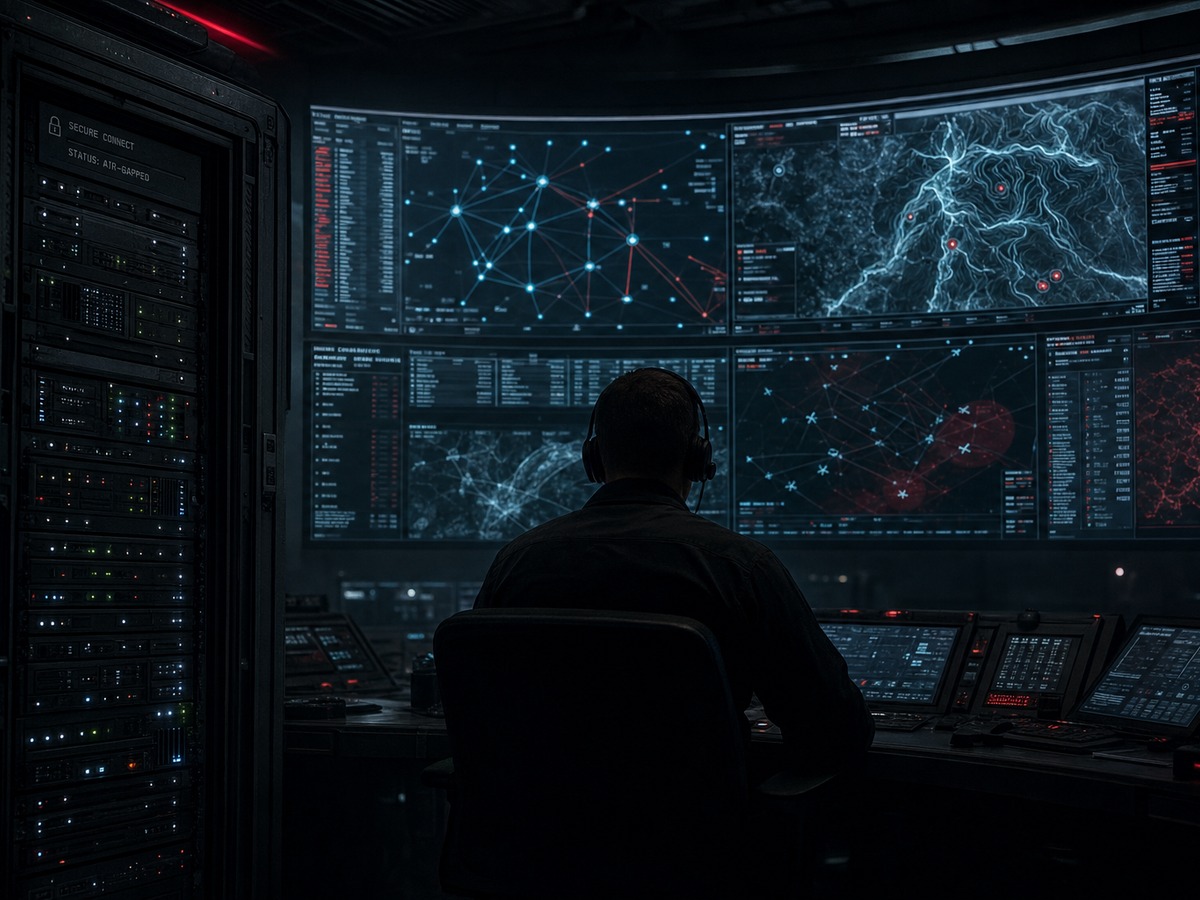
Air-gapped command post with situational awareness displays
Problem · Cognitive load

The cognitive burden on the soldier

Modern operations degrade decision-making capacity long before they degrade equipment. Eight recurring factors drive that cognitive burden, and each is measurable, addressable and traceable to a design requirement in our architecture.

  • Information overload — Drones, sensors and command nets push more data than a soldier can process in real time, producing decision fatigue and slower reaction times.
  • Environmental stressors — Extreme temperature, altitude and noise degrade cognitive function while complex tasks still have to be completed.
  • Physical exhaustion — Extended vigilance, load carriage and exertion without rest raise error rates and slow problem solving.
  • Psychological stress — Threat of injury, exposure to trauma and moral dilemmas add anxiety and long-term cognitive load.
  • Technological complexity — Advanced equipment demands higher training and sustained cognitive engagement, often under fire.
  • Multitasking — Navigating, communicating and engaging simultaneously drives cognitive overload.
  • Sleep deprivation — Prolonged operations impair attention, memory and judgement.
  • Chemical exposure — Intentional or environmental exposure affects cognitive performance and brain health.
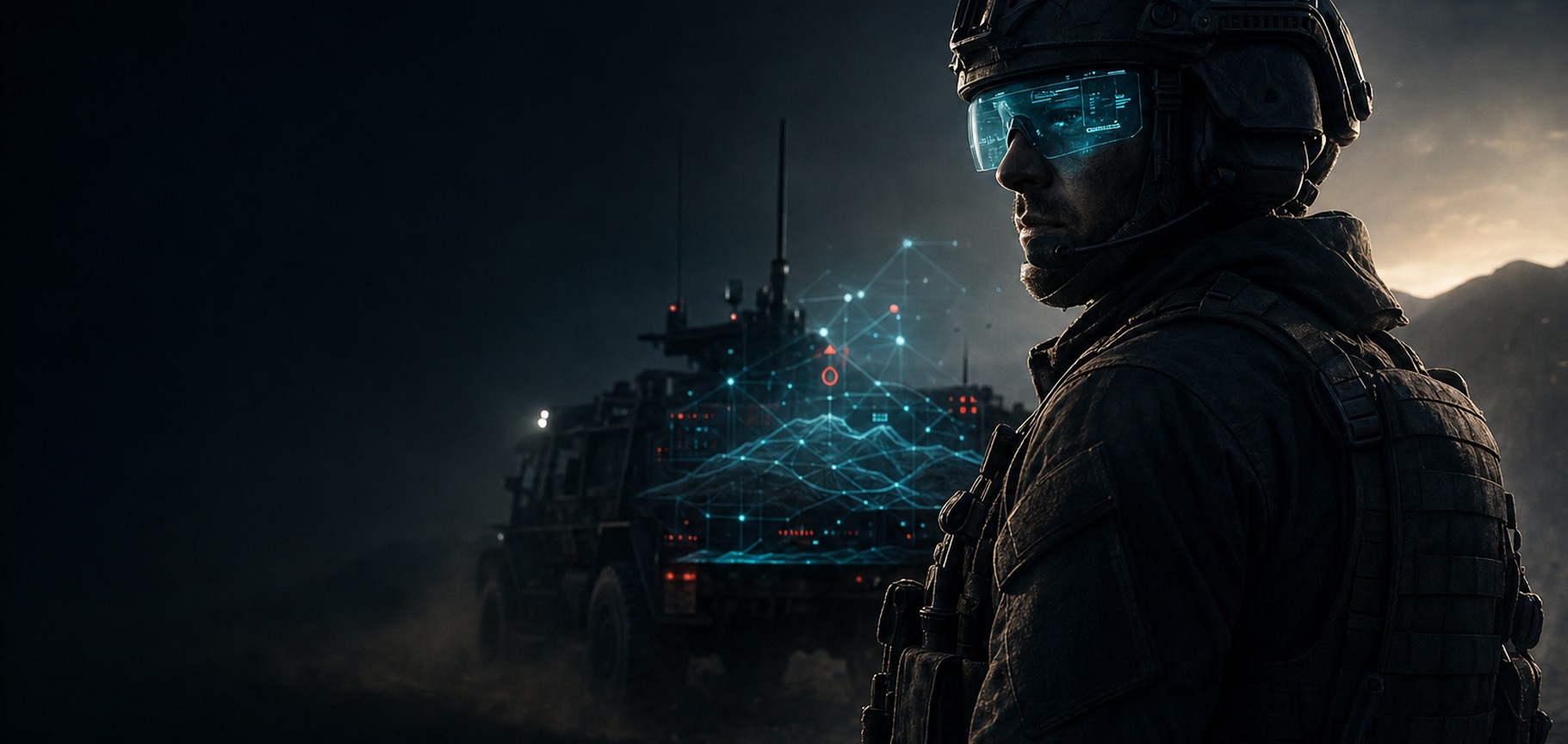
Soldier with a heads-up display supported by an AI assistant
Solution · Soldier as a system

A personal AI and LLM assistant

Local versions of large and small language models, distributed across the devices carried by a section under the commander’s control, put a private assistant in the hands of every soldier — no connectivity, no external service, no data leaving the unit.

  • Information processing, synthesis and filtering under time pressure
  • Report summarisation, text classification and standard message drafting
  • Ballistic, route, weather, soil and battery-endurance calculation
  • Speech-to-text, text-to-speech and language translation on the move
  • Maintenance and repair guidance as a hands-free voice assistant
  • Medical advice, training schedules and adaptive skill development
  • Mixture-of-experts models split across squad devices to fit edge hardware
Request the concept note
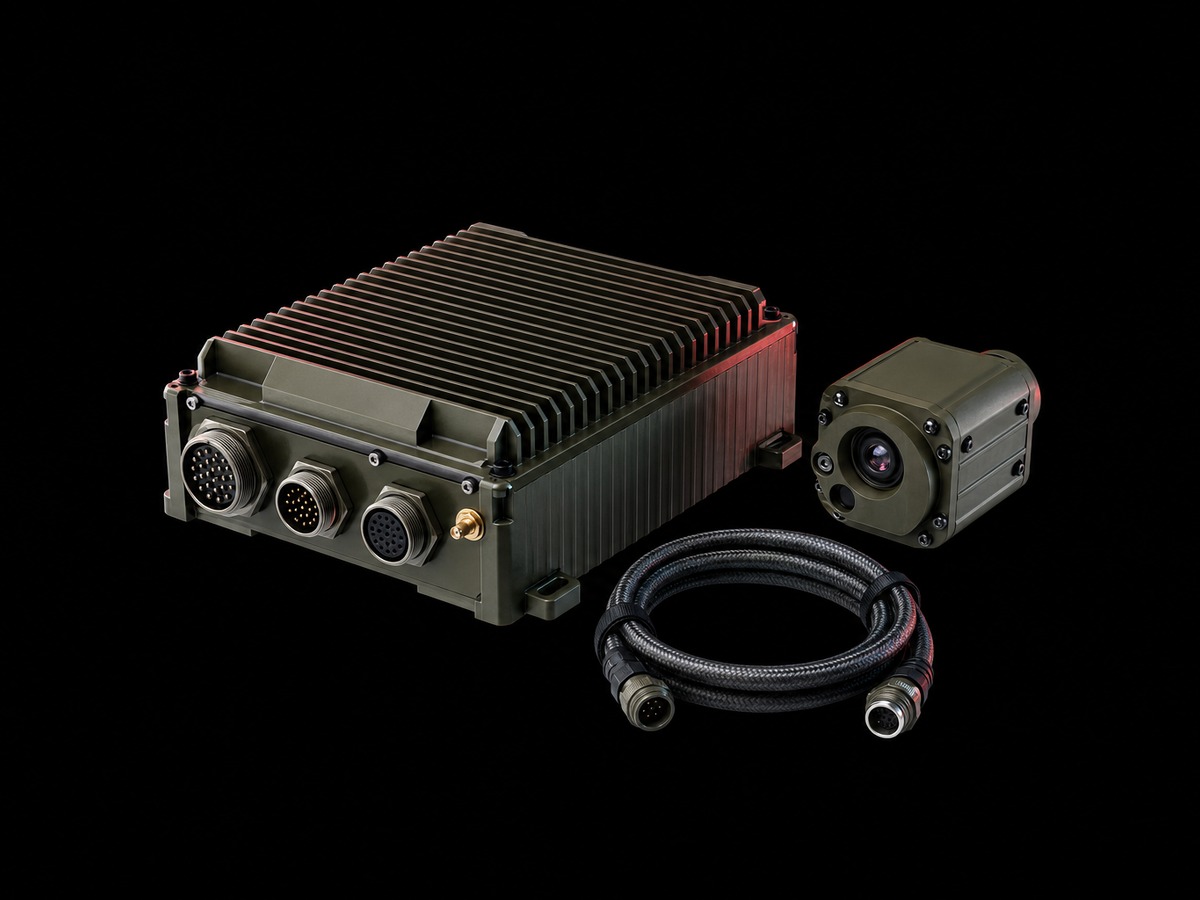
Ruggedised edge computing module and sealed sensor pod
Hardware · Edge and on-premises

Compute where the data is created

Inference runs on hardened edge modules at the sensor and on an on-premises GPU cluster at the formation level. Nothing traverses a public network, and the deployment survives the loss of every external link.

  • Ruggedised edge compute nodes for sensor-side pre-processing and fusion
  • TEMPEST-certified server hardware in the secure processing enclave
  • On-premises accelerator cluster hosting the reasoning models
  • Hardware security modules holding all encryption keys
  • Sealed gateways and a private broker between every zone

Mission Use Cases

Situational Awareness & Threat Analysis

Fuses radar, EO/IR, RF and wearable sensor feeds into one interpreted picture, flagging anomalies and probable threat behaviour rather than raw tracks.

Intelligence Summarisation

Condenses long reports, signals traffic and imagery annotations into mission-relevant briefs at the classification level of the querying user.

Mission Planning & Simulation

Retrieves doctrine, terrain and past after-action reports to generate and stress-test courses of action before orders are issued.

Real-Time Decision Support

Answers the soldier's question in under a second and, where authorised, dispatches an action through a validated rules engine.

Predictive Maintenance

Learns platform and weapon telemetry to predict failures, recommend repair strategy and act as a voice assistant during the repair itself.

Knowledge Management & Training

Turns manuals, SOPs and lessons learned into an always-available tutor with adaptive skill development paths for each user.

Stress & Well-Being Monitoring

Reads physiological signals to track stress in real time, offers personalised recovery recommendations and routes confidential support resources.

Standard Message & Order Generation

Fills standardised forms, generates urgent voice messages by text-to-speech and drafts combat orders from map graphics.

Seven-Layer Architecture

The reference design separates acquisition, processing, knowledge, orchestration, reasoning, action and assurance. Each layer is independently securable, independently scalable and deployable inside an air-gapped enclave.

01

Sensor Data Acquisition

Military-grade IoT sensors and wearables feeding hardened edge compute nodes through secure gateways and a private message broker.

02

Data Processing & Integration

TEMPEST-certified servers with GPU compute, event streaming and sensor fusion for multimodal text, audio, video and telemetry inputs.

03

Secure Knowledge Base

A self-hosted vector store for embeddings alongside document, time-series and graph databases, with keys held in hardware security modules.

04

Agent Orchestration

An agent framework that decomposes a request, prioritises tasks and coordinates retrieval, tools and models over an event-driven bus.

05

RAG Reasoning Engine

Locally hosted large and small language models on an on-premises GPU cluster, with prompt isolation, token-level filtering and optimised inference serving.

06

Action Dispatch

A rules engine with multi-level validation and a secure API gateway, so every triggered action is authorised and written to a tamper-proof audit trail.

07

Security & Monitoring

Deep packet inspection, military-grade SIEM, behaviour-based anomaly detection and formal verification of safety-critical logic.

Performance, Security & Scale

Performance targets

Sensor-to-action latencyUnder 500 ms end to end
Language model responseUnder 300 ms (95th percentile)
Sensor scale1,000+ sensors sampled at 10 Hz
Event throughput10,000 events per second
Availability99.999% target
Knowledge base10 TB, scaling to 100 TB
Concurrent users500+

Security specification

DeploymentFully on-premises, air-gapped; no external cloud dependency
Data at restAES-256 encryption, HSM-managed keys
Data in transitTLS 1.3 with military-grade cipher suites
Forward securityQuantum-resistant algorithms where standardised
AuthenticationMulti-factor: biometric and hardware token
AuthorisationRole-based access with attribute-based policies
AuditTamper-proof logging of every query and dispatched action

Scalability

HorizontalContainer orchestration with sharded databases
VerticalGPU and memory expansion within the existing rack footprint
GeographicMulti-site distribution with secure inter-site synchronisation
Offline resilienceContinued operation and automatic failover when links are lost
Knowledge growthNew corpora indexed without retraining the base model

Delivery Roadmap

Delivery is phased over roughly thirty months from contract award: initiation and use-case selection, proof of concept, procurement and security certification, core development and integration, then deployment, training and hypercare.

01

Proof of Concept

Use cases frozen, reference data prepared, embeddings and retrieval evaluated on a contained corpus.

02

Prototype

Sensor ingestion, orchestration and the reasoning engine wired together on procurement-grade infrastructure.

03

Minimum Viable Product

Security certification, action dispatch under validation and field trial with a nominated user unit.

04

Full Development

Scale-out, integration with existing systems, deployment, training and a hypercare period before steady-state support.

Differentiators

Complete data sovereignty

Fully on-premises and air-gapped. No query, embedding or document ever leaves the customer’s infrastructure.

Military-grade security

TEMPEST-certified hardware, HSM-backed keys, prompt isolation and tamper-proof audit of every action.

Real-time performance

Edge processing keeps the sensor-to-action loop under half a second even at formation scale.

Operational resilience

Designed to keep working offline, with automatic failover and degraded-mode operation.

Adaptable knowledge base

New doctrine, lessons learned and sensor types are indexed continuously without retraining the base model.

Ethical and accountable AI

Every answer cites its retrieved sources, and consequential actions stay under human authority.

Risks & Mitigation

Programme risk register

Hardware supply chainEarly procurement initiation, qualified alternate vendors and indigenous integration of imported compute.
Model performance limitsDomain fine-tuning, retrieval grounding and human-in-the-loop validation for every consequential output.
Security vulnerabilitiesAir-gapped architecture, prompt isolation, red-team review and formal verification of critical paths.
Integration with legacy systemsAdapter-based interfaces and staged cut-over with fallback to existing procedures.
Data qualityComprehensive digitisation with metadata standards and curation before indexing.
User adoptionOperator-led design, embedded training and transparent citation of every retrieved source.
Engineers reviewing a risk matrix and network topology beside a locked, air-gapped server cage
Assurance review against an air-gapped enclave — in-house visualisation, indicative only.

This page summarises Steadfast’s AI in Defence concept and reference architecture. Performance figures are design targets for the reference deployment, not measured results from a fielded system. Configuration, model selection, hosting and certification scope are agreed with the customer, and no classified material should be submitted through the enquiry form. Imagery on this page is an in-house visualisation and is indicative only.

Contact Form

Export enquiries are processed subject to Indian end-user certification and DGFT clearance.